
Edge vs Centralized: Choosing the Right ALPR Processing Architecture
A practical breakdown of edge vs centralized ALPR processing—and why the smartest systems combine both.
Introduction
When planning an ALPR system, one of the most important design decisions is where the processing should happen.
- Should recognition take place close to the cameras at the edge?
- Or should video streams be sent to central servers for analysis?
This choice affects:
- Bandwidth usage
- Alert timing
- Scalability
- Infrastructure cost
- Long-term flexibility.
Understanding how edge and centralized processing differ—and how they can complement each other—helps you design a system that performs reliably as it grows.
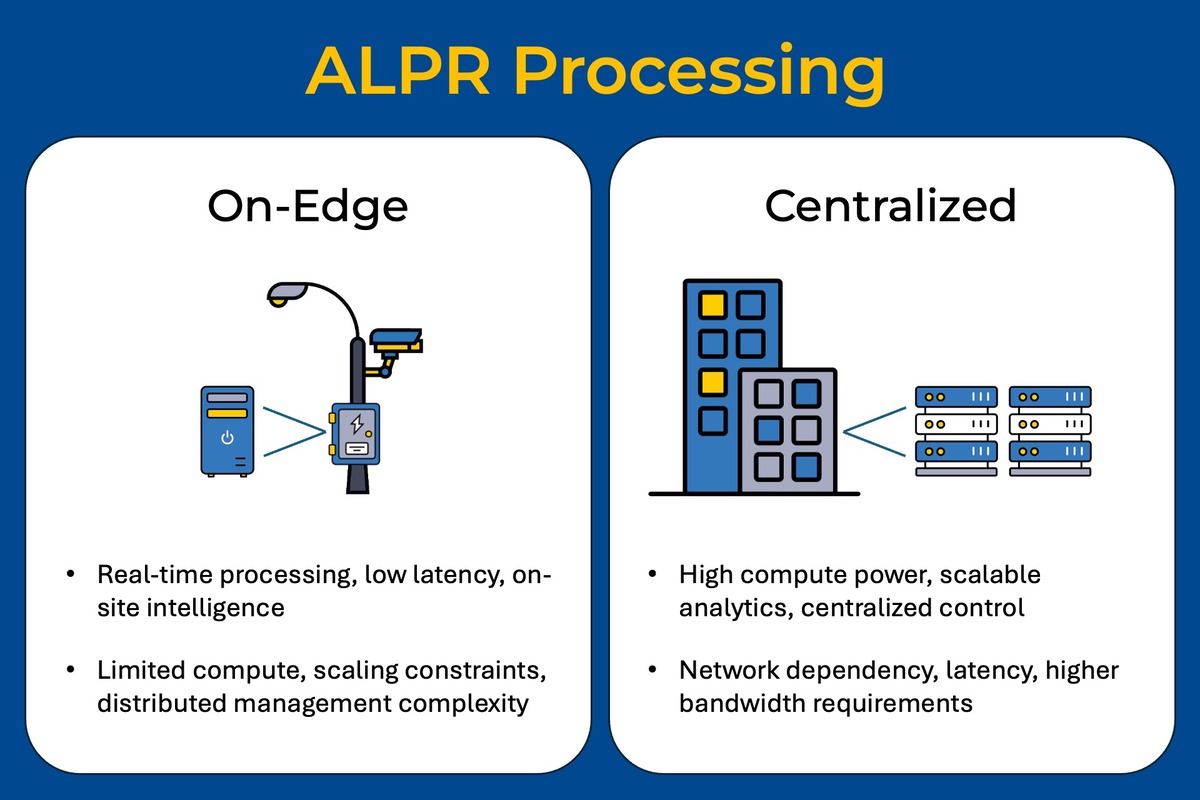
Edge-Based ALPR Processing
Edge processing means recognition happens near the camera. This could be directly on a camera device or on a dedicated edge PC or appliance that handles one or more cameras.
In this model, video is analyzed locally, and only the processed results are sent to central servers.
Instead of streaming full video continuously across the network, the system extracts license plate numbers, vehicle attributes, and selected image snapshots at the edge.
That structured data is then transmitted centrally for alert matching, user consumption, analytics, and storage.
Advantages of Edge Processing
- Reduced bandwidth usage
Because only extracted data and images are transmitted, the network carries far less traffic than full video streams. This is especially important for remote sites or locations relying on limited broadband or cellular connections.
- Improved resilience in unstable networks
If the connection between the site and central servers briefly drops, recognition can still occur locally. Vehicles are captured and processed without depending entirely on uninterrupted video transport.
- Lower central infrastructure load
Since video is not being decoded and analyzed centrally, backend servers can focus on alert matching, analytics, and user management instead of raw video processing.
Limitations of Edge Processing
- More hardware required at each site
Edge devices must have enough computing power to perform recognition. As deployments expand, this means maintaining distributed processing hardware across multiple locations.
- Alert logic still depends on central servers
Software updates, monitoring, and maintenance must be handled across many edge nodes rather than in one centralized environment.
- Ongoing device management
Even if recognition happens at the edge, the recognized data is typically sent to central servers where watchlists are checked and alerts are distributed. Edge processing reduces bandwidth, but it does not eliminate the need for centralized coordination.
Centralized ALPR Processing
In a centralized model, cameras stream video to a central data center or cloud platform where ALPR processing occurs. Recognition engines operate in one location, analyzing video feeds from multiple sites.
This architecture shifts the heavy computational workload away from individual locations and concentrates it in powerful central servers.
Advantages of Centralized Processing
- Simpler edge devices
Cameras and local hardware can be lighter and less expensive because they are not responsible for performing recognition tasks.
- Easier software management
Recognition algorithms and updates can be deployed in one place, reducing the complexity of maintaining distributed devices.
- Stronger cross-site analytics
When all video streams are processed centrally, it becomes easier to correlate vehicle activity across locations and perform large-scale searches and reporting.
Limitations of Centralized Processing
- High bandwidth requirements
Streaming video from multiple sites consumes significant network capacity. If connections are limited or expensive, this can quickly become a bottleneck.
- Dependency on connection stability
Vehicles are often visible to a camera for only a fraction of a second. If video frames are lost during transmission, detections may be missed entirely. The reliability of the connection between sites and central servers becomes critical.
- Potential alert delays in weak networks
When video must travel first and then be analyzed centrally, alert timing depends heavily on network speed and stability.
A Balanced Approach: Combining Edge and Centralized Processing
In real-world deployments, the most effective architecture often combines both edge and centralized processing.
In a balanced model:
- Edge devices handle initial recognition and extract core vehicle data.
- Central servers perform alert matching, user notification, record storage, and deeper analytics.
- Selected image data may be post-processed centrally to enrich results or validate detections.
This approach allows each layer to perform the tasks it handles best. Edge devices reduce bandwidth pressure and preserve detection reliability in environments where connectivity may fluctuate. Central servers provide scalability, advanced analytics, and coordinated alert distribution across users and locations.
The right distribution of processing depends largely on network conditions.
- If the connection between sites and central infrastructure is fast, stable, and cost-effective, more processing can safely occur centrally.
- If the connection is limited, expensive, or prone to interruption, more processing should remain at the edge to ensure vehicles are not missed.
Alert timing also reflects this balance. Even when recognition happens at the edge, the final alert typically originates from central servers after watchlist checks and user routing decisions. In centralized models, the video must first travel and be analyzed before that same alert workflow begins. The overall speed therefore depends less on labels like “edge” or “centralized” and more on how well the system is architected.
A thoughtfully designed hybrid architecture provides flexibility. It allows organizations to adapt processing levels as deployments expand, network conditions change, or analytics needs grow. Instead of committing fully to one model, the system can evolve with operational requirements.
Conclusion
Edge and centralized ALPR processing each solve different challenges. Edge reduces bandwidth usage and improves resilience at the site level. Centralized processing simplifies management and enables powerful, large-scale analytics.
The most reliable systems combine both approaches in a deliberate way. By aligning processing location with network realities, infrastructure capacity, and long-term growth plans, organizations can build an ALPR architecture that performs consistently today and scales confidently tomorrow.
Looking to elevate your security infrastructure with cutting-edge LPR solutions?
We are just a phone call away. Call us today at (813) 749-0892 for a free consultation.
LICENSE PLATE RECOGNITION (LPR): THE ULTIMATE GUIDE TO VEHICULAR INTELLIGENCE
PlateSmart’s deep dive into License Plate Recognition and its immense contribution to security agencies and businesses.
Frequently Asked Questions About ALPR Processing
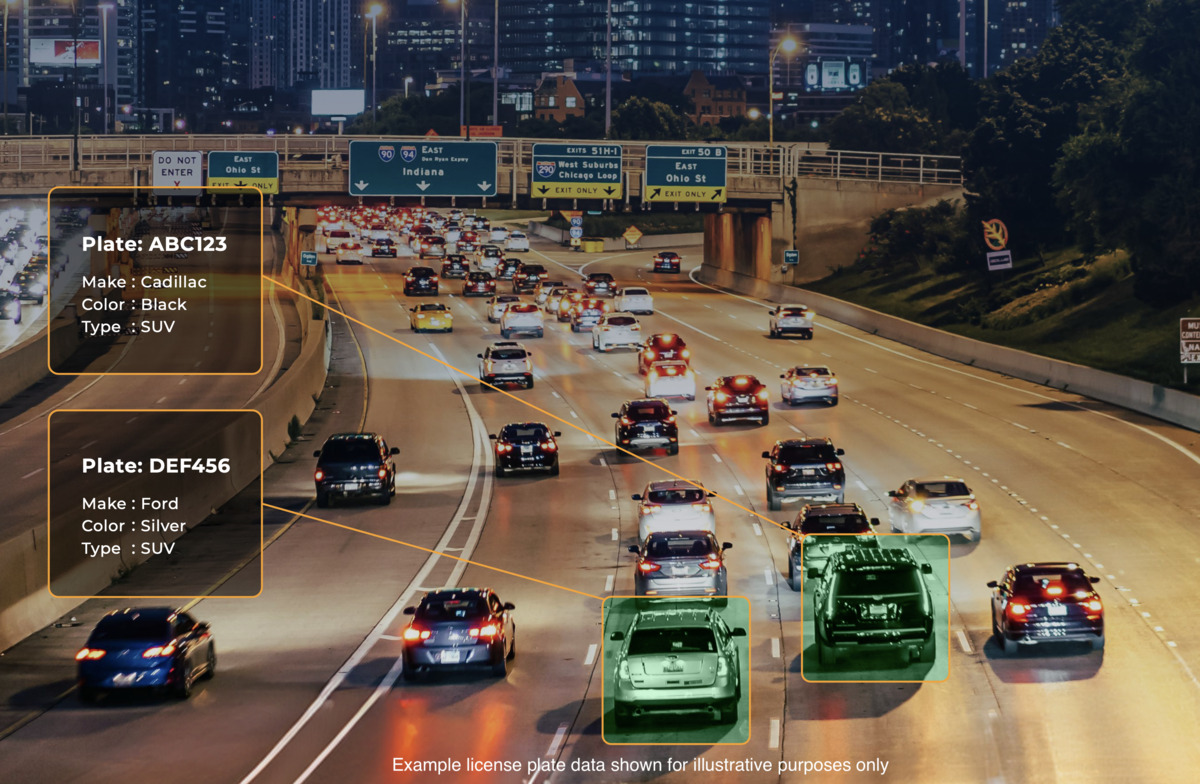
(The visuals on this page are stock images, used for illustrative purposes only)