
ALPR Analytics - From Vehicle Data to Actionable Intelligence
A single capture is a record. How you analyze thousands of them — across locations, over time, at speed — is where the intelligence begins.
Introduction
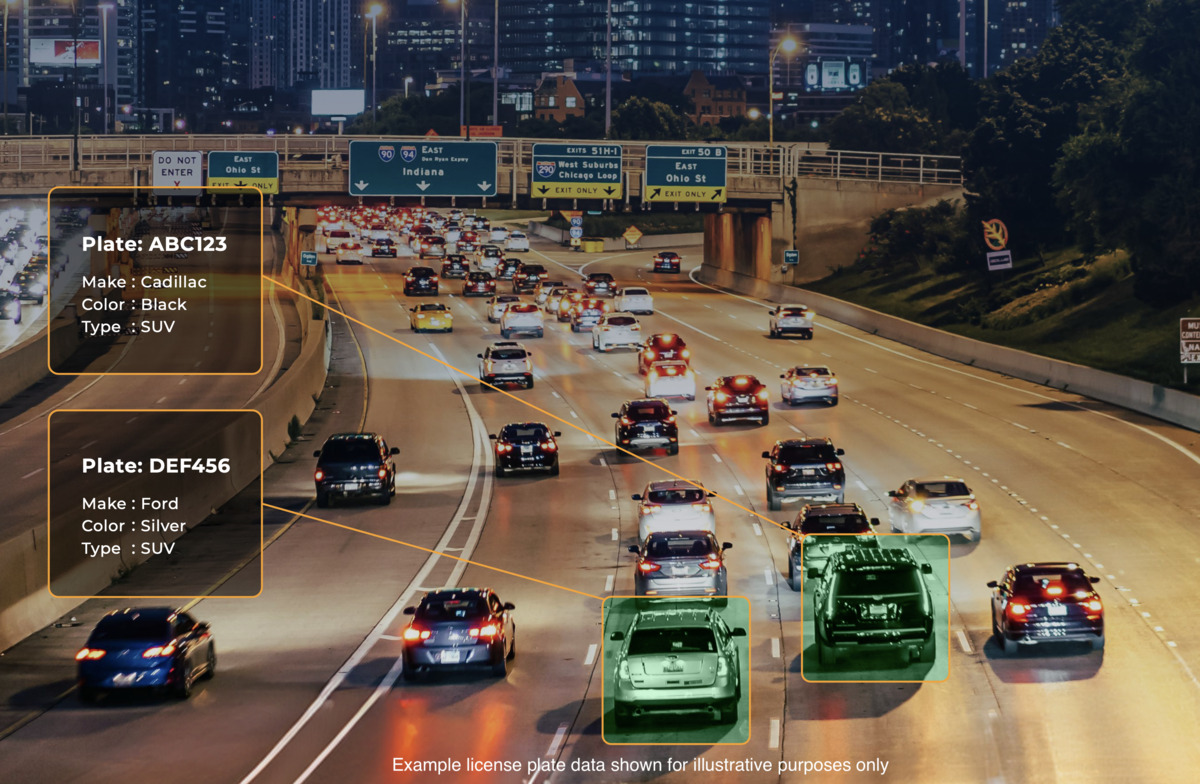
Every time a vehicle is captured by an ALPR system, it leaves behind data points. The plate number, timestamp, location, vehicle make and color, etc.
Individually, these captures are records. Collectively — across hundreds of cameras, thousands of daily reads, and months of operational history — they become something far more powerful: a living intelligence layer that reveals patterns that would be very difficult for human analysts to detect, and transforms how organizations make decisions.
PlateSmart's analytics engine is built on this principle. It doesn't just read plates. It connects them — across time, geography, and context — and delivers the intelligence that drives faster investigations, leaner operations, and smarter resource deployment.
This page explains how that works, what it looks like in practice, and why the way PlateSmart is built makes its analytics more durable and more valuable over time than alternatives.
What ALPR Analytics Actually Does
Raw ALPR data is a stream of events. Analytics is what happens when that stream is interrogated. PlateSmart's analytics platform performs several distinct functions, each building on the one before it.
Real-Time Detection and Alerting
The most immediate analytics function is matching. Every plate captured is instantly compared against configurable watchlists. For comparison against State BOLOs, NCIC databases and agency-defined hotlists, a law enforcement agency sponsorship is required and is for law enforcement use only.
When a match occurs, the system triggers an alert in real time, giving officers immediate notification of the vehicle's presence and exact location. Every alert is also logged, creating a complete audit trail from detection to response.
What bolsters PlateSmart's alerting capability is not just speed but precision. The system captures vehicle make, model, color, and type alongside the plate — so a match can be cross-referenced against vehicle description immediately, reducing false positives and giving officers more information before they act.
Historical Search and Investigation Support
Real-time alerting catches what's happening now. Historical search answers questions about what happened before. PlateSmart's search and filtering engine lets analysts query across weeks or months of captured data using any combination of criteria:
- Plate number (full or partial)
- Date and time range
- Vehicle make, model, or color
- Vehicle type
- Camera location or geographic area
Results return in seconds, regardless of database size.
This matters enormously in investigations where time is a constraint — an analyst who can pull every sighting of a suspect vehicle across an entire region in under a minute has a fundamentally different capability than one waiting minutes or hours for a query to resolve.
PlateSmart is engineered for this speed at scale, not just at low data volumes.
Pattern Recognition and Behavioral Analysis
This is where analytics moves from reactive to proactive. PlateSmart's engine doesn't just retrieve individual records — it identifies relationships between them. Key pattern-recognition capabilities include:
- Movement corridor mapping: Identifying which routes a vehicle consistently uses, at what times, and between which locations — building a behavioral profile from aggregated sightings
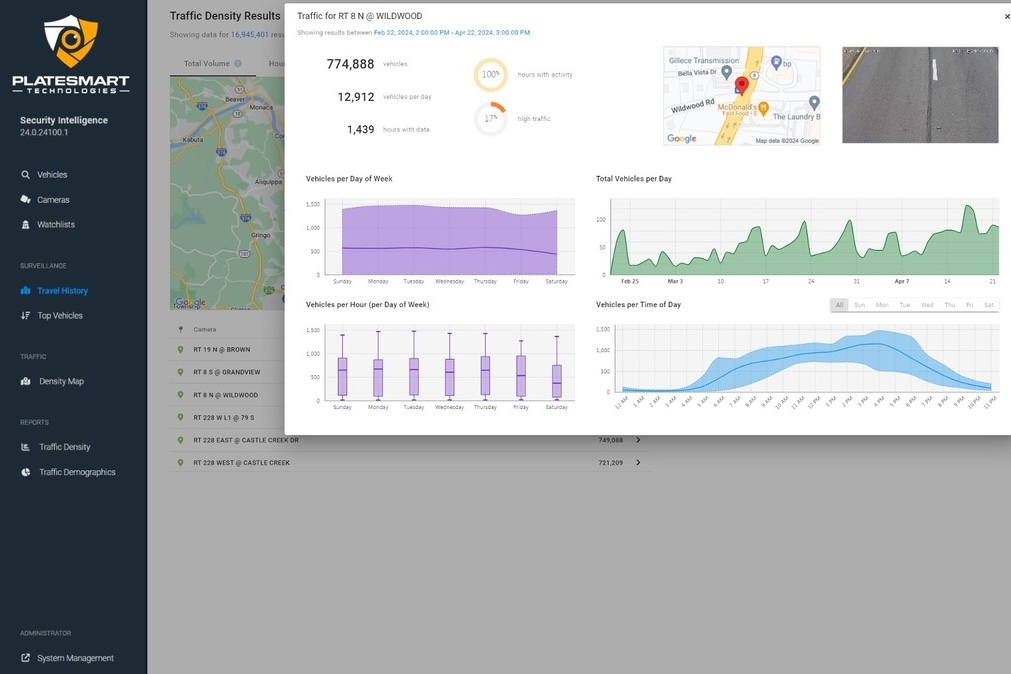
- Heat map analysis: Visualizing vehicle concentration across locations and time periods, revealing hotspots of activity that correlate with incidents or operational inefficiencies
- Frequency and dwell analysis: Detecting vehicles that appear repeatedly in a location over time, flagging behavior that may indicate surveillance, repeat offending, or process delays
- Cross-location correlation: Connecting sightings of the same vehicle across geographically separate camera networks — essential for investigating mobile criminal operations that cross jurisdictional boundaries
- Vehicle cross-search: Finding patterns of vehicle activity across multiple locations and times for the purpose of identifying potential criminal activity.
Predictive Positioning
The most advanced application of pattern analytics is predictive deployment.
When movement corridors, day/time patterns, and vehicle behaviors have been established through historical analysis, investigators and operations managers can make data-driven decisions about where to position resources — not based on intuition, but on what the data says is most likely to happen next.
This transforms ALPR from a documentation tool into a true force multiplier.
Why PlateSmart Analytics Gets More Powerful Over Time
Most technology depreciates. You buy it, use it, and eventually replace it because something newer renders it obsolete. PlateSmart is designed to invert this pattern — and the reason lies in its software-only architecture.
Because PlateSmart is a software platform, not a hardware system, the analytics capability is decoupled from the cameras capturing the data. This has a compounding effect over time.
As clients upgrade cameras — whether moving to higher resolution, expanding coverage points, or simply replacing ageing hardware — the underlying analytics engine continues without interruption.
Historical data is preserved. Search indexes remain intact. Behavioral patterns that have been building for months or years remain queryable. There is no system rebuild, no data migration loss, no break in the intelligence record.
This also means clients can mix and match hardware from different manufacturers, choosing the best camera for each specific deployment context. For example, a wide-angle unit at a parking lot entrance, a high-speed capture unit at a highway checkpoint, or an optically powerful unit for long distance ALPR capture.
And they can do all this while running a single, consistent analytics layer across all of them. No other ALPR approach offers this flexibility without analytical fragmentation.
Your Data Stays Yours — Completely
Some ALPR vendors treat their customers' vehicle data as a secondary revenue stream. They aggregate it, sell it to data brokers, or use it to build commercial databases that serve entirely different purposes from the ones their customers signed up for. PlateSmart has been vocally opposed to this practice since its founding, and its architecture reflects that position.
Vehicle data captured through PlateSmart remains entirely within the control of the deploying organization — on their infrastructure, governed by their retention policies, and auditable at every point of access. The platform's comprehensive audit trail shows exactly who accessed what data, when, what they searched for, and whether any system configurations were changed.
For law enforcement agencies with CJIS compliance obligations, this auditability is not optional — it's a certification requirement. For commercial organizations managing sensitive customer data, it is a fundamental accountability measure.
PlateSmart gives agencies full control over data retention periods, including the ability to purge data automatically after a configured interval. Organizations that need to balance operational intelligence value against privacy obligations can set policies that reflect their specific legal environment, rather than being forced into a vendor's default data-retention model.
Learn more about PlateSmart's approach to ALPR data privacy →
Analytics in Action Across Industries
The same analytical engine operates differently depending on the questions being asked of it. Here is how PlateSmart analytics translates into operational intelligence across three of the industries it serves most actively.
Law Enforcement
For investigators, ALPR analytics is the difference between reactive policing and intelligence-led operations. Real-time alerts catch known vehicles as they move through a camera network.
But the more powerful function is retrospective — rebuilding the movement history of vehicle license plates of interest, which could expose even an entire criminal operation from accumulated data. Consider what this looks like in practice.
- Vehicle theft ring case:
In a high-end vehicle theft investigation, detectives used PlateSmart Analytics to query data from 35–40 cameras across a regional network.
The analysis revealed that the same fictitious plate numbers were appearing on multiple vehicles simultaneously — a direct signature of plate swapping. Heat map analysis identified consistent travel corridors the stolen vehicles used. Day and time analysis helped predict when and where the vehicles could next appear.
Officers positioned themselves accordingly, tracked the suspects to their operational base without a high-speed pursuit, and recovered over $300,000 in stolen vehicles — along with one of the region's largest-ever fentanyl seizures.
How heat maps and predictive positioning dismantled a theft ring: Vehicle Theft Ring Case Study →
- Credit card fraud case:
In a multi-state credit card fraud investigation, PlateSmart's cross-location tracking connected U-Haul truck movements between rental locations and major retailers across five states.
Critically, the system captured more than just plates — it documented truck identification numbers and distinctive vehicle markings, allowing investigators to work backwards from partial information when plates weren't visible.
Pattern analysis turned isolated incidents into a coherent map of a criminal network's operation, enabling predictive positioning and targeted surveillance rather than reactive response.
How pattern analysis cracked a multi-state fraud ring: Credit Card Fraud Investigation Case Study →
These cases illustrate what separates analytics-driven law enforcement from traditional methods:
- Investigations that previously required hundreds of hours of manual footage review complete in minutes
- Criminal connections across jurisdictional boundaries become visible without manual coordination between agencies
- Officers deploy resources based on data-predicted behavior, not intuition — reducing risk and increasing effectiveness
See these capabilities across four real investigations: LPR in Law Enforcement: 4 Real-World Use Cases →
Rental Car Operations
For rental car fleet managers, analytics converts vehicle movement from an untracked operational cost into a managed, measurable process.
The questions being asked are different from law enforcement — not "where did this suspect go?" but "where is Vehicle 4721 right now, why has it been in the cleaning bay for three hours, and how does today's processing pace compare to our seven-day average?"
PlateSmart helps managers answer these questions by capturing vehicle info at the natural checkpoints of a rental operation — return lots, cleaning bays, maintenance facilities, staging areas — and thus helping calculate vehicle dwell time at each stage. Managers gain visibility into:
- Bottleneck identification: Which specific stage in the processing workflow is accumulating delays, and during which shifts
- Real-time status tracking: Every vehicle's current location and processing status, across multiple sites simultaneously
- Throughput benchmarking: How today's turnaround times compare against historical baselines, enabling trend identification before problems escalate
- Cross-location fleet intelligence: Vehicle distribution across multi-site operations, supporting smarter rebalancing decisions based on demand data rather than guesswork
- Unauthorized use detection: Alerts triggered when vehicles exit operational areas outside expected parameters — catching after-hours employee use before it becomes a liability pattern
The financial logic is direct. If analytics-driven workflow optimisation reduces average vehicle turnaround time by even a small percentage across a large fleet, the additional revenue compounds significantly at scale.
See the full operational picture: ALPR for Rental Car Fleet Management →
Retail
For retail loss prevention teams, ALPR analytics does something that no in-store camera system can: it monitors the behavior of vehicles across a parking lot and across multiple store locations simultaneously.
Since virtually all organized retail crime involves vehicles — both for transporting stolen merchandise and for coordinating multi-person operations — the parking lots and approach roads are where patterns become visible long before the crime reaches the store floor.
PlateSmart's retail analytics layer works on two fronts — surfacing threat signatures before incidents occur, and accelerating investigations when they do:
- Repeat visit detection: Vehicles appearing at the same location multiple times within a short window — a behavioral signature of "casing" activity, where criminals surveil a target before acting
- Cross-location correlation: The same vehicle appearing at multiple store locations within a geographic cluster over hours or days — a strong indicator of an organized retail crime operation moving between targets
- Hotlist matching: Immediate alerts when vehicles previously associated with incidents at any location in a retailer's network are detected entering a parking lot, enabling security deployment before a crime occurs
- Post-incident investigation: When a theft or fraud event occurs, investigators can use ALPR data to immediately help pull the complete vehicle record for the incident time window — every vehicle on the property, with timestamps, making suspect identification dramatically faster
Beyond security, the same analytics engine delivers operational and commercial intelligence.
Traffic pattern analysis across a parking lot reveals peak arrival periods, dwell time distributions, and customer flow that informs staffing decisions, store layout, and promotional placement.
Vehicle make data can inform co-marketing opportunities with local businesses.
Curbside pickup programs can be automated — when a customer's registered plate enters the lot, their order is triggered for preparation automatically, reducing both wait time and manual staff workload.
See how analytics supports retail security and operations: Combat Organized Retail Crime With PlateSmart ALPR →
The Intelligence Advantage
The organizations that get the most from ALPR analytics are not necessarily the ones with the most cameras or the largest budgets.
They are the ones that approach the system as an intelligence platform rather than a surveillance tool — asking not just "what did this vehicle do?" but "what is the pattern, what does it predict, and what should we do about it?"
PlateSmart's analytics engine is built to support exactly this kind of thinking. The data stays yours, grows continuously more coherent as your deployment matures, and remains fully queryable regardless of what hardware changes you make along the way.
Whether you are building an investigative case across a wide geographic area, finding the cleaning bay that's costing you thirty minutes of turnaround time per vehicle, or identifying a repeat offender before they reach your store floor — the intelligence is in the data.
PlateSmart's job is to uncover it.
Ready to see what your vehicle data is telling you?
Call (813) 749-0892 for a free consultation.
Looking to elevate your security infrastructure with cutting-edge LPR solutions?
We are just a phone call away. Call us today at (813) 749-0892 for a free consultation.
LICENSE PLATE RECOGNITION (LPR): THE ULTIMATE GUIDE TO VEHICULAR INTELLIGENCE
PlateSmart’s deep dive into License Plate Recognition and its immense contribution to security agencies and businesses.
Frequently Asked Questions About ALPR Processing
(The visuals on this page are stock images, used for illustrative purposes only)